How to save a recipe from a cookbook page
Photographing the page is the easy half. The rest of a cookbook recipe is scattered through the book, and here is how to get all of it.
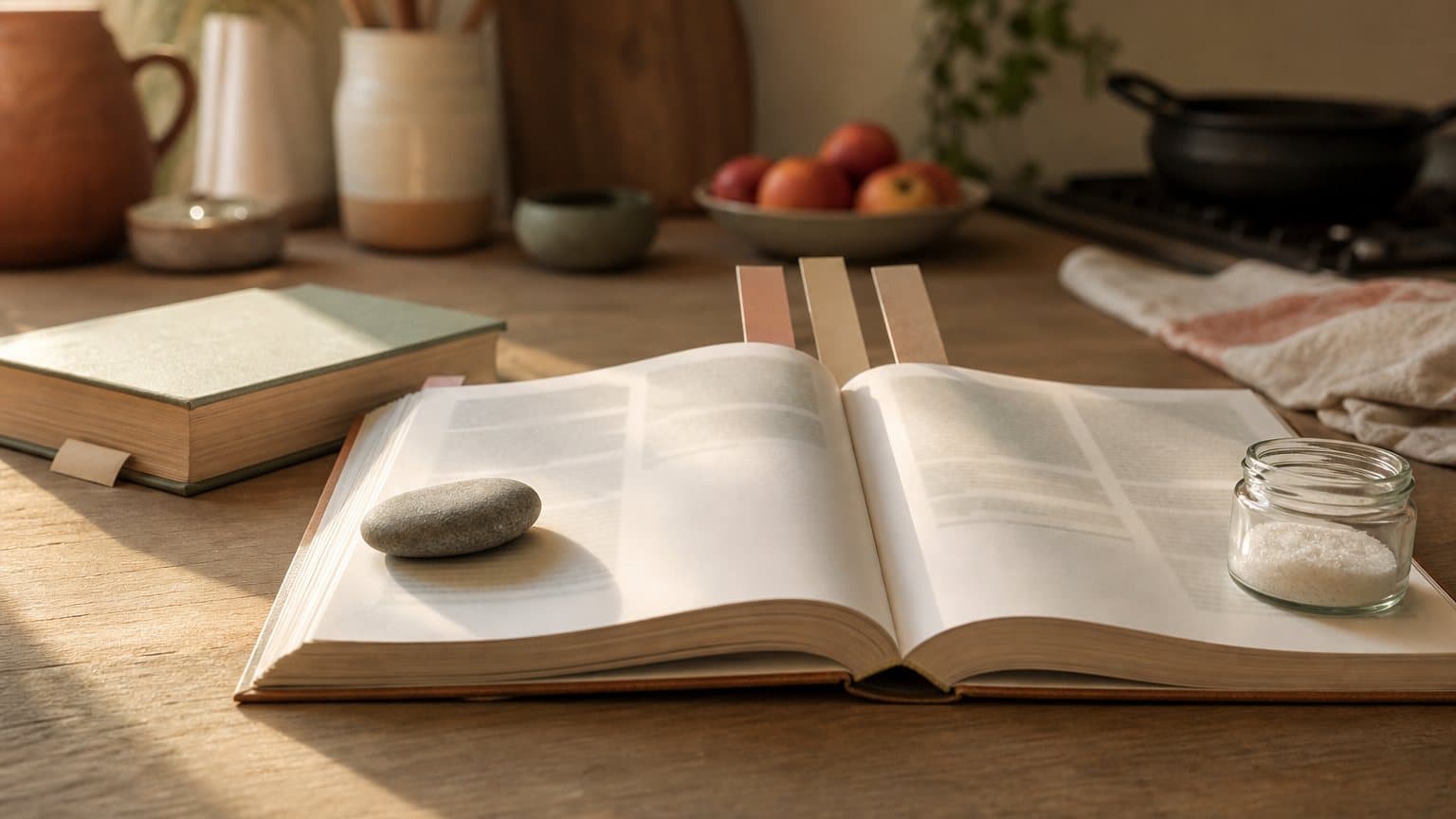
Open the book flat, weight the pages down with something heavy, and photograph one page at a time from directly above in window light: page number included, and both halves of the spread if the recipe runs across it. Then do the part almost everyone skips: chase whatever the page points at. The oven setting that lives in the chapter introduction. The pastry that says see p. 212. The tin size buried in the headnote. Photograph those as well, or type them into the recipe while the book is still open.
That second half is the actual job. A recipe card is a complete document. A cookbook page is not, and was never trying to be.
A cookbook page is a fragment, on purpose
A recipe on a website has to stand alone. It has no idea what else you have read, so it repeats the oven temperature, spells out the tin size, and explains what to do with the pastry every single time. That is why web recipes are padded, and it is a reasonable response to the problem they have.
A cookbook does not have that problem. The author knows you own the whole book. So the good ones stop repeating themselves: the chapter introduction explains the master method once, page twelve says which salt the book means, the back has the conversion table, and page 187 can then say "roll out the sweet shortcrust (p. 212), line a 28 cm tin" and get on with it.
This is a feature. It is most of what separates a cookbook you cook from all year from a printout. But it means the page in front of your camera is a node in a document, not the document. Photograph the page and you have captured the node.
What the camera captured
One page. Ingredients, method, a page number, probably a photo of the finished thing on the facing side.
What the recipe actually is
That page, plus the four or five things it assumes you can turn to. Take the book away and some of them stop being answerable.
You find out which ones on a Sunday afternoon, halfway in, with the book back on the shelf at your parents' house.
Where the other half of the recipe lives
Before you photograph anything, read the page once looking only for pointers, the bits that quietly refer to somewhere else. They are nearly always in the same six places.
The headnote
Yield, tin or pan size, resting time, and "start this the night before". The most consequential information on the page is regularly in the least recipe-looking paragraph.
The chapter introduction
Oven setting, the master method, how the author wants you to treat the main ingredient. Written once, twenty pages before the recipe.
The front matter
The author's definitions. Which salt, which flour, whether a cup is 240 ml or 250, what "a medium onion" means in this book. Fifteen pages nobody reads that redefine every quantity after them.
A cross-reference
"See p. 212." A base recipe (a stock, a dough, a spice mix) that is a whole second recipe standing between you and dinner.
The facing page
Long recipes run over the spread, and the last three steps end up under the photograph. Easy to miss on the shelf and impossible to notice later.
The back of the book
Conversions, gas marks, a glossary, sometimes a table of roasting times the recipes all defer to.
Six places sounds like a lot of work. In practice a given recipe points at two or three of them, and finding out which takes about a minute with the book already open, which is the only moment it is cheap.
Resolve the pointers, then save
The move that makes a cookbook recipe survive leaving the book is to write in the answer instead of the reference. Where the page says pastry: see p. 212, put the pastry in the ingredient list with its quantities. Where it says moderate oven, put the number. Where it says 1 stick of butter, put 113 g, if you cook in grams.
You lose nothing by doing it. The book still exists, the page number is still on your photo, and you can always go back. What you gain is a recipe that works in a kitchen that does not contain the book.
Page 187, plum and almond tart
- Pastry: see p. 212
250 g plain flour, 125 g cold butter, 60 g icing sugar, 1 egg yolk
- Oven: as for the tarts in this chapter
190°C fan, on the shelf below the middle
- Serves 8, the tin the book assumes
28 cm loose-bottomed tart tin
- Salt: see p. 12
Fine sea salt. The book halves the quantity if you only have flaky
One recipe. Cookable with the book back on the shelf.
four pointers, resolved before saving
The other reason to do it now: a cross-reference is only resolvable while you have the book. Borrowed from a library, read in a shop, photographed at a friend's house: those are exactly the cases where you will never get a second look at page 212, and they are also the cases where people photograph fastest and least carefully.
Photographing a book, specifically
Most advice about photographing recipes is written for loose paper. A bound book has its own failure modes, and they are worth ten minutes of care because a bad photo means doing the whole thing again.
The gutter is where text goes to die. The curve into the spine bends the last centimetre of every line and throws it into shadow. Photograph one page at a time rather than the spread, and hold that page as flat as it will go without forcing the binding. Then shoot from directly above the centre of that page, not the centre of the book.
Do not crack the spine to get it flat. On an old or a much-loved book that is a bad trade. Two photographs of a slightly curved book beat one photograph of a broken one.
Glossy paper reflects everything. Window light coming in from the side works; the ceiling light directly above you will put a bright patch exactly where the ingredients are. If you can see a reflection through the phone, move, do not zoom.
Keep the page number in frame. It is your citation, it is how you find the recipe again in the physical book, and it is how you know which page the cross-reference wanted.
Photograph what the page points at, in the same session. Page 212, the chapter opener, the conversion table. It costs three more photos while the book is open and saves an unanswerable question later.
If the recipes you are digitising are handwritten, the trade-offs are different (the artefact matters as much as the text) and digitising handwritten recipe cards covers that case properly.
What Sugo does with a cookbook page
Sugo reads a photograph of a page as a recipe rather than as an image. What comes back is structured: title, ingredients with quantities and units separated out, numbered steps, timings. You check it, correct anything odd, and save it into a cookbook alongside everything else you have kept, whatever it originally came from.
Page 187
Plum and almond tart
Serves 8 · 28 cm tin · 1 h 10
250 g plain flour, 125 g cold butter, 60 g icing sugar, 1 egg yolk.
Rub the butter into the flour until it looks like coarse sand, work in the sugar and the yolk, then chill the pastry for an hour before you roll it.
Plum and almond tart
Ingredients
Method
Photographed · p. 187
From there it stops behaving like a page. It is searchable, so the tart is findable by "almond" or by half a memory, and you never have to remember which book it was in. It gets matched against your pantry, which is what decides whether it shows up as something you could cook tonight or something that needs a shop first. And cook mode gives you one step at a time with its timer: which is the thing a cookbook is genuinely worst at, because a book has no interest in staying open at page 187 while your hands are covered in butter.
What this does not do well. Three failure modes, and they are all shapes of page rather than shapes of recipe.
The first is layout. A page laid out in two columns, or with a sidebar running down the edge, or with the ingredients set in a tinted block beside the method, gets read in the wrong order surprisingly often. What you get back is all the right words in a jumbled sequence, which is quick to fix but does need reading.
The second is display type. Chapter openers with the first line set large across a photograph, recipes printed in a script face, coloured text on a coloured ground: all of it is harder to read from a photo than plain body text, and older books with small, tight type are harder again.
The third is the one this whole post is about, and it is not solvable by better reading: nothing can follow see p. 212 for you unless you photographed page 212. The pointer comes through as text, faithfully, and it stays a pointer. Resolving it is a decision about your kitchen (your tin, your units, your salt) and it stays yours. Same story with the video version of this problem, where the amounts exist but are scattered across a runtime rather than across a book: saving a recipe from a YouTube video covers that one.
Whose recipe it is
Keeping a personal copy of a recipe from a book you own, so you can cook it, is ordinary. It is what people have done with index cards for a century.
Republishing it is a different thing, and the fact that a photograph makes it trivial does not make it acceptable. Keep the book title and the page number attached to your copy. It costs a line, it is genuinely useful when you want the headnote back, and it is the difference between a personal note and a reproduction. If a recipe becomes one you cook constantly, buy the book. That is what pays for the next one.
Before you close the book
Every pointer resolved
Read your saved copy and search it for "see", "p.", "opposite" and "as above". Anything still pointing somewhere is a hole.
The oven setting written down
The single most common thing a cookbook states once, in a chapter introduction, and never repeats.
Tin, pan and tray sizes
A tart built for a 28 cm tin does not work in a 23 cm one, and the size is usually in the headnote rather than the ingredients.
Units converted the way you actually cook
Sticks, cups and gas marks are fine if you use them. If you do not, convert now, while the book's own conversion table is in front of you.
Book and page number kept
Your citation, and your route back to everything you decided not to photograph.
The short version
Photograph the page, then resolve what the page assumes.
A cookbook is a well-edited, internally consistent document, and every one of those qualities depends on the rest of it being within reach. The moment you take one page out, the page needs to be made complete, and that is a five-minute job with the book open, or an impossible one without it.
Sugo is free on iPhone, iPad and Mac, on Android, and in any browser at app.sugo.kitchen. If your best recipes are in books you have to be at home to cook from, download Sugo.