Why recipes take longer than they say
Recipe times count only the steps someone could time. Why prep time runs long, why 30-minute meals rarely take 30, and how to read a recipe before you cook.
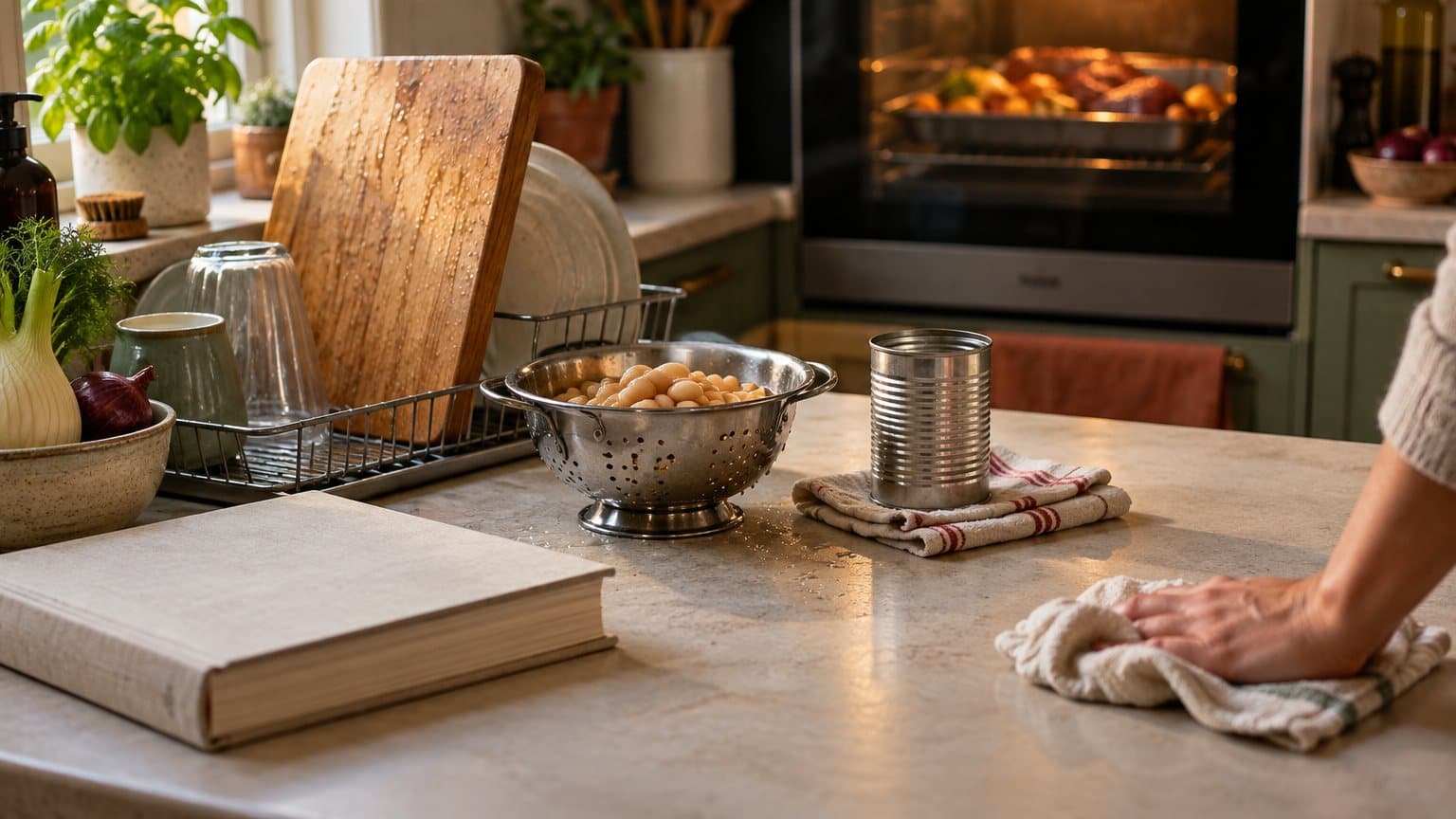
A recipe that says "ready in 45 minutes" has added up the stretches its writer could put a number on. Your evening also contains the stretches nobody numbers: reading the method through, clearing enough counter to work on, finding the roasting tin, rinsing a tin of beans, washing the board between the onion and the sausages. Those are real minutes and the total does not know about them.
The total is also the wrong shape. It adds minutes that need your hands to minutes that need only a clock, as if those were the same unit. A minute of risotto and a minute of roasting are different things, and which kind you have decides more about the evening than the total does.
Doubling the printed time fixes neither problem. Read a recipe's times twice before you cook instead: once for what was never counted, once for which minutes are yours and which belong to the oven.
Why prep time runs long and cook time doesn't
A printed time is usually a real measurement. Somebody cooked the dish, probably four or five times, and wrote down how long the parts took. The problem is whose kitchen it was measured in. By the fifth attempt the writer knew the dish by heart, had the tin on the counter, had the oven on before touching an onion, and had a second board for the sausages. None of that is cheating, but it describes a different evening from your first go at the dish on a Tuesday.
Of the two numbers on a recipe card, one is far more trustworthy than the other. Cook time is the oven's number, and an oven does not care whose kitchen it is in: forty minutes at 200C is forty minutes everywhere. Prep time is a claim about a person, and it was measured on somebody who had done this before with everything already out.
The second problem is about scheduling, and the arithmetic hides it. Two recipes can both print 45 minutes and give you completely different evenings.
Forty-five minutes of risotto
Every one of those minutes is yours. Stirring, ladling, tasting, judging when the rice has gone from chalky to just short of done. You cannot lay the table during a risotto, and you certainly cannot start the washing-up.
Forty-five minutes of traybake
Ten minutes of chopping and tossing, then thirty-five minutes in which the kitchen does not need you at all. The dressing, the table, the glass of wine and most of the washing-up fit inside the roast.
Both say 45. One of them costs you forty-five minutes of attention; the other costs you ten and then hands the rest back. When you are choosing a recipe for a weeknight, that split matters more than the ingredient list does.
What the total time leaves out
Here is a sausage and butter bean traybake from a weeknight book: prep 10, cook 40, fifty minutes. The method runs to three steps. Chop the fennel and red onion. Toss them with the sausages, the oil and a squeeze of lemon. Roast for forty minutes, turning once. The arithmetic is correct and the cooking really does take fifty minutes.
Then there is everything else the evening held.
One traybake, timed twice
What the recipe adds up
50min
What the evening added up to
65min
Never named, never skipped+15 min
Reading the method through before anything goes on
4 minClearing enough counter to work on
3 minWashing the board between the onion and the sausages
3 minFinding the roasting tin, which lives under the grill pan
3 minOpening and rinsing the butter beans
2 min
None of those five stretches is a flaw in the recipe. A method that opened with "clear the counter, then find the roasting tin, which is under the grill pan" would be unreadable, and no writer can know which of your tins is buried. They get left out for good reasons, and they still cost fifteen minutes.
They also scale with how new the dish is to you. The reading and the finding roughly double on a first attempt, because you read the method twice and you go looking for things you have not needed before. A recipe you have cooked six times has almost no joins left in it, which is exactly why the writer's measurement came out at fifty.
Three recipe phrases that always run long
About five minutes, until golden
Onions that have softened and turned translucent are five to eight minutes. Onions that are actually golden-brown and sweet are twenty to thirty on a domestic hob, and plenty of recipes that want the second write the first. Deep brown, jammy onions take longer still, often forty-five minutes or more. If the dish tastes of its onions, budget the twenty and keep the heat lower than you want to.
Prep time
Measured on a cook with peeled garlic, a sharp knife, a clear board and five previous attempts. Weighing flour into a bowl is thirty seconds on the fifth go and three minutes on the first, and the gap between those two numbers is most of what prep time hides.
Meanwhile
The word that asks you to be two people. "Meanwhile, make the sauce" is free when the other pan needs nothing from you, and it costs you when the other pan is a risotto or a roux. Check what the first pan is doing before you accept the invitation.
Hands-on time vs clock time
Before you start, spend thirty seconds on these instead of on the total.
The first is the chain of minutes that need your hands, joins included. On the traybake above that is roughly twenty-five: ten of method, fifteen of housekeeping. Those minutes are strictly serial. Nothing overlaps them, because you are the thing they all need.
The second is the longest stretch that needs only a clock. On the traybake that is the forty-minute roast. A clock stretch is free capacity, and whether you get to spend it depends entirely on where it falls. If it comes last, you eat at hands plus clock and there is nothing to be done about it. If it comes first or in the middle, every hands-on minute you can move inside it comes off the end of the evening.
So start the slowest clock-only thing first, before you pick up a knife. An oven from cold needs twelve to twenty minutes to reach a real 200C, whatever the dial says when the light goes off. A pot of water takes eight to twelve. Rice, dried beans and a pan of stock are all the same kind of minute. Every one of those you start before chopping is a stretch you get back, and every one you leave until the method mentions it is a stretch added to the end.
This is also why "prep everything first, then cook" is good advice that occasionally backfires. Full mise en place is the right move when the cooking is attended and fast, like a stir-fry, where you genuinely have no spare hands later. On a braise or a traybake it can mean standing in a kitchen chopping while an oven that could have been heating is still cold.
Where Sugo comes in
The useful intervention on a Tuesday is a small one: one step in front of you, with that step's timer attached, so a clock stretch is running from the moment it starts. That is what cook mode in Sugo is for.
In cook mode the current step gets the whole screen, the timer for that step starts with the step instead of being set up separately, and the ingredients tick off as they go in. The practical effect on timings is that the unattended stretch becomes visible while it runs, which is the moment you would otherwise forget you had thirty-five free minutes and spend them watching an oven. It pairs with the physical setup in cooking without touching your phone, and if you are choosing between recipes for a whole week rather than one evening, a meal plan that survives a real week is about the same arithmetic at seven times the scale.
Sugo keeps whatever times the source gave it, so an imported recipe that says "soften the onions, 5 minutes" still says five minutes. There is no model of how hot your hob runs, no learning from how long you actually took last time, and no warning when the next three steps all want your hands at once. Those would each be useful and none of them exist. The times you get are the recipe's own, attached to the steps they came from, where a wrong one is at least in front of you rather than buried in the fourth sentence of a paragraph.
Questions people ask
Does prep time include preheating the oven?
Usually not. In most recipes preheating sits outside both numbers, and an oven from cold needs twelve to twenty minutes to reach a real 200C (400F). Turn it on before you start chopping and those minutes overlap the prep instead of following it.
What is the difference between prep time, cook time and total time?
Prep time is the hands-on work before the heat, measured on someone who has made the dish before. Cook time is how long the food spends in the oven or on the hob, and it is the more reliable of the two. Total time adds them together, which treats minutes that need your hands and minutes that need only a clock as one unit, and it leaves out reading the method, finding equipment and washing up between steps.
Why do 30-minute meals take longer than 30 minutes?
The 30 counts the steps the writer could time, on a cook who knew the dish and had everything out. Reading the method, clearing the counter, finding the right pan and rinsing a tin of beans are not in it. On the traybake above, those added fifteen minutes to a fifty-minute recipe.
How long does it really take to caramelize onions?
Softened, translucent onions take five to eight minutes. Golden-brown, sweet onions take twenty to thirty on a home hob, and deep brown, jammy ones often take forty-five minutes or more. When a recipe says "about five minutes, until golden", budget the twenty.
How much extra time should I add to a recipe?
About fifteen minutes the first time you cook it, for reading the method twice and looking for equipment. After two or three attempts the recipe's own number is roughly right. Starting the oven or the water before you chop wins back more time than any padding.
Reading a recipe's times before you cook
Read the method through, once
Four minutes, and it is the cheapest of all of this. It is also where you find the hour-long marinade and the butter that should have come out of the fridge.
Underline every number you could set a timer for
Those are the honest ones. The stretches with no number are where the evening goes.
Mark which of those numbers need you
A roast, a braise, a rest and a rise are free. A risotto, a roux, a custard and anything described as "stirring constantly" are not.
Start the longest free stretch first
Oven, water, rice, beans, stock. Before the knife, not when the method gets round to mentioning it.
Add fifteen minutes the first time
You will read the method twice and go looking for a tin. By the third attempt the recipe's own number is about right.
A recipe's printed time measures the cooking. What you want on a Tuesday at seven is a measure of the evening, and that has a different answer in every kitchen, which is why no writer can give it to you. Fifteen minutes of housekeeping, a hob that runs cooler than theirs and an oven you forgot to turn on make up the gap, and you can close all three.
Sugo is free on iPhone, iPad and Mac, on Android, and in any browser at app.sugo.kitchen. If dinner keeps landing half an hour after you told everyone it would, download Sugo.
