How to run a dinner party from three kitchens
Three cooks, three courses, one table. The plan is in none of the three recipes, so here is how to build it backwards from the hour you eat.
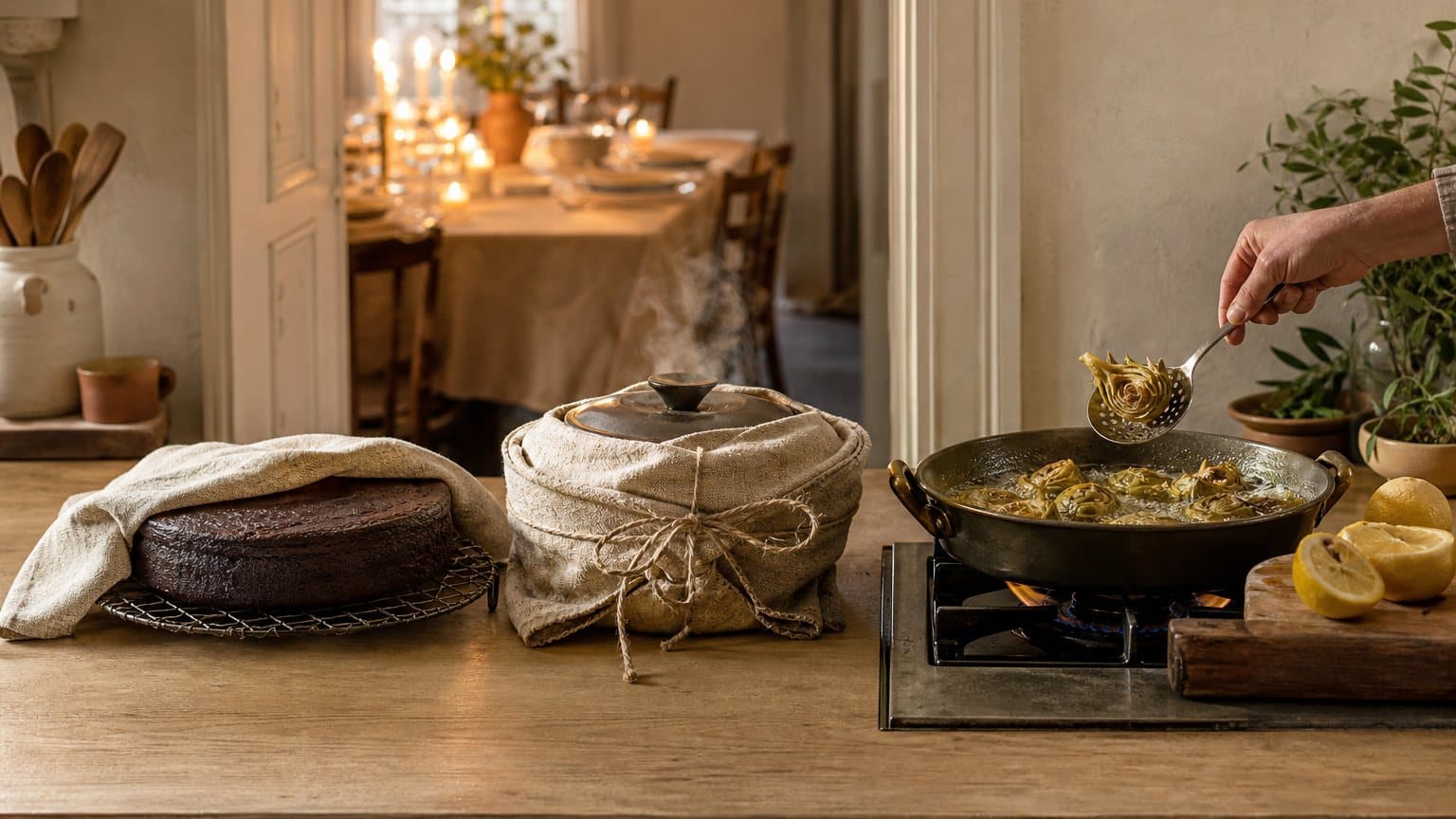
Fix the hour you are eating before you agree the menu. Then get two numbers out of each kitchen: how long that course takes, and how long it is still good once it is finished. Work backwards from dinner with both numbers and you get three start times, one per cook, which is the whole plan.
The second number is the one that decides the evening. A course that will happily sit for an hour can be cooked by anyone, anywhere, at almost any time. A course that is only good for four minutes has to be cooked in the room with the table in it, by whoever is not carrying anything. If that is impossible, change the course.
Everything below details those two paragraphs, plus the four things that go wrong anyway.
Each recipe is written as though it were the only one
Open any recipe and every duration in it is measured from its own beginning. Twenty minutes in the oven, twenty minutes from when you put it in. Rest for ten before slicing, ten after its own step seven. Nothing in it refers to anything happening in another house.
Put three of those side by side and you have three private clocks and no shared one. One kitchen knows its course takes an hour and fifty. Neither it nor anybody else knows when to start, because starting is a fact about the evening, and the evening is not in the recipe.
What a recipe gives you
Ingredients, an order, and durations counted from the moment you begin. All of it correct, all of it about one dish, none of it about tonight.
What three kitchens need
One minute everyone is aiming at, and for each course, the latest it can start and the longest it can wait once it is done. Two numbers per cook and a time on a clock.
The number that matters is how long it waits
The four-hour braise sounds like the hard part of the evening, and it is the easy part. Short ribs that have been in the oven since mid-afternoon will sit in their own fat getting better while you find the corkscrew, and if somebody is forty minutes late they improve. The cook can leave the house.
The twenty-five-minute course is where the evening breaks. Fried artichokes, a risotto, anything dressed, anything with a crust: done is a narrow window and after it the dish is a worse version of itself. Almost everybody plans as if cooking time were the thing to coordinate, because cooking time is printed on the recipe and the other number is not written down anywhere.
So ask for it in those words: "how long will yours sit once it is ready". "How long does yours take" gets you the number already printed on the recipe. Expect a range, and take the bottom of it, because people are optimistic about their own food.
One caveat before the arithmetic: this is a question about whether a dish is still worth eating. Whether it is safe to eat is a separate question with its own rules, and not one to settle from a blog post.
Work backwards from the minute you sit down
Pick the minute first. Then, for each course, lay its waiting time back from that minute, and its cooking time back from there. Where you land is when that kitchen starts.
Three kitchens, one table at eight
At the table20:00
Chocolate and olive oil cakeKitchen one
On at 14:20Better cold than warm, so the whole afternoon is spare time. This is the course to give to whoever is least confident.
Short rib ragù, pappardelle to followKitchen two
On at 14:30Four hours of not being needed. The pasta is twelve minutes at the other end and belongs to whichever kitchen the table is in.
Fried artichokes with lemonKitchen three
On at 19:35Twenty-five minutes that cannot be moved, cannot be done early, and cannot travel. The shortest bar on this chart is the one that sets the whole evening.
Two cooks have been free since half six. The third is in hot oil while everyone else is pouring wine.
Read the chart once and the arrangement is obvious in a way it never is in a message thread. Kitchen one could have cooked at ten in the morning. Kitchen two put the oven on at half two and has been reading a book since half six. Kitchen three is standing over a pan at twenty-five to eight, which means kitchen three is not pouring anyone a drink, not answering the door, and not sitting down when everyone else does.
Notice also what three kitchens give you for free. The thing a single kitchen fights over is space: one oven at two temperatures, four hob rings and five pans, a worktop with no room to rest a board. Split the meal three ways and that scarcity vanishes. What stays scarce is attention in the last half hour, and splitting the meal makes that worse, because three people are each having their own last half hour and nobody can see the other two.
Give the unforgiving course to the room with the table
This is the one rule worth remembering, and the chart above is where it comes from.
If the food is travelling, the last-minute course belongs to whoever is hosting. They are already in the kitchen it has to be finished in, they are not driving, and they do not have to get a pan hot in somebody else's house. Everything that travels should be happy in a cold car and happier reheated, which is most braises, most tarts, most cold things and almost nothing fried.
If nobody is travelling, because all three of you are eating at your own tables with a call open, then there is no room with the table in it. In that case drop the unforgiving course altogether. Three cooks eating in three houses can manage three courses, as long as each chose something that will wait, and cooking the same meal with someone in another city goes through the dish shapes that forgive a gap.
Four things that go wrong, and none of them is the cooking
Nobody cooked the gaps
Bread. Butter. Water on the table. Ice. Something to drink before anyone sits down. Coffee at the end. Three people each own a course and the rest of the evening belongs to no one, which is discovered at ten past eight.
Three different numbers of people
One course scaled for four, one for six because the recipe said six, the pudding for eight because the tin is the tin. In one kitchen you notice. Across three nobody notices until it is on the table.
The journey is an unlisted step
Packing, twenty minutes in a car, finding a shelf in a strange oven, and getting the dish back to the temperature it was at when it left. That is half an hour of real work and no recipe mentions it.
The last twenty minutes
All three courses want hands at once near the end. One cook reading one recipe would spot the pile-up while reading. Three cooks reading three recipes each see a perfectly reasonable evening.
Write one plan, not thirty messages
A dinner party across three kitchens produces a remarkable volume of messages and almost no plan. The plan is the short list of facts that belong to the evening and to none of the three dishes, and it takes about ten minutes to write.
One page everyone opens, settled before Saturday
Put it somewhere that is not a message thread: by Saturday afternoon it will be forty messages up and the person who needs it will be holding a pan. A shared cookbook works best, because the three recipes can live in it too, in one version, with the quantities already agreed.
Where Sugo helps, and where it does not
Everything above works with a pen. Two parts of it are genuinely annoying without software, and those are the parts Sugo does.
The three recipes go in a shared cookbook, so all three cooks are reading the same version of each course rather than three forwarded links with different quantities. Edit the ragù to serve six and it is six for everyone. At the stove, cook mode puts one step on the screen at a time with its timer attached, which matters more than usual when you are also watching a clock that belongs to two other houses. Where the phone goes is the other half of that, and cooking without touching your phone covers it.
And where two of you are cooking the same thing, a cook party takes the timekeeping out of your hands. One invite, everyone joins from their own kitchen, lanes show where each cook has got to, and the timers are shared, so a simmer ends at the same moment in both houses whoever started it. At the end everyone photographs their plate and the photos stay covered until the last person has served. Party size goes by plan: one guest free, up to four on sugo+, up to ten on famiglia.
Cook party
Voice on
What it does not do
A cook party is built around one recipe. Three different courses in three kitchens is more than one party can hold, so an evening like the chart above is three separate parties, or, more usefully, one party for whichever course two of you are making together. The backwards schedule itself is yours to work out: there is no field anywhere in Sugo for how long a dish will wait, and nothing in the app will tell kitchen three to start at 19:35.
It also will not fix the shopping. Three kitchens means three shops, and a shared cookbook does not divide a list between households. Ask Sugo will suggest a swap for something one of you cannot buy, and a suggested swap can be plausible and wrong, so somebody still has to decide. And everyone needs the app open and a connection that holds, which a kitchen with bad wifi does not have.
Running one, in order
Fix the hour before the menu
Everything else is calculated from it, including which of you has to leave work early.
Get both numbers from each kitchen
How long it takes, and how long it will wait. Ask for the second one in those words, because nobody volunteers it.
Send one start time to each cook
A clock time needs no interpreting at six in the evening by somebody who is already holding a knife.
Put the least forgiving course nearest the table
Or take it off the menu. Those are the two options and the second one is not a failure.
Name who owns bread, water, ice and coffee
Out loud, on the plan, before Saturday.
Decide who says when to sit down
Somebody has to call it. Otherwise all three cooks wait politely for the other two and the artichokes go cold.
The short version
A dinner party split across three kitchens is a scheduling job, and the schedule is not in any of the three recipes, because each one was written as though nothing else were happening that night.
So write it down yourself. One serving time, two numbers per course, three start times, and the one course that cannot wait put in the room where people are going to eat.
Sugo is free on iPhone, iPad and Mac, on Android, and in any browser at app.sugo.kitchen. If you have ever carried a casserole across a city and arrived to find no oven free, download Sugo.