How to cook the same meal with someone in another city
Cooking together at a distance fails for one reason: a video call carries the talk but not the pot. How to share the recipe itself instead.
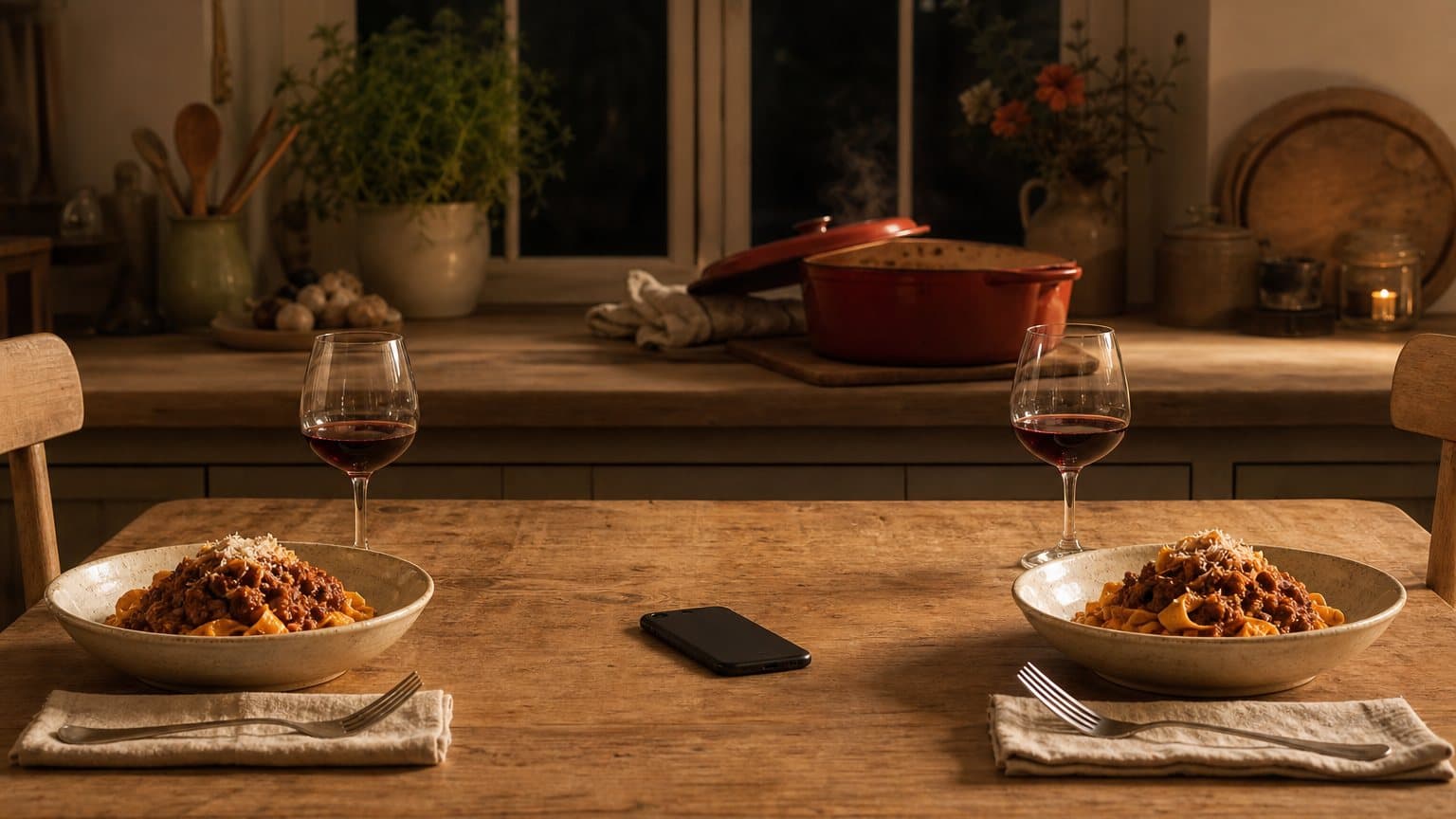
Pick a dish with one long step in it. Agree on a single written version of the recipe before either of you shops. Do your chopping before you call. Then put the phone on speaker rather than on video, and start at an hour you have both actually agreed on instead of assumed.
That is most of it, and the surprising part is the speaker. Cooking with someone in another city is not a video problem. It is a synchronisation problem, and pointing a better camera at it does not help.
A video call carries the wrong thing
When two people cook in one kitchen, almost nothing gets said about the recipe. Nobody announces that they are still on the onions. The other person can see the pan, hear the pan and smell the pan, so where the dish has got to is simply available, and the talking is free to be about something else entirely.
Take that kitchen apart and put nine hundred miles between the halves, and the talking survives perfectly. Phones have been good at talking for a century. What does not survive is the pan. Neither of you can see where the other is, so the state of the recipe has to be narrated, and narration is expensive. Every "where are you?" and "still chopping" is a sentence that existed in neither kitchen before.
That is why cooking on a video call feels like two people cooking near a phone rather than two people cooking together. The call carries the conversation, which was never the hard part.
What the call carries
Faces, voices, the dog walking through the shot. Everything you would have said anyway, at good quality, from a phone propped somewhere it will eventually get splashed.
What one kitchen carries
All of that, plus the thing nobody mentions: where the dish is. Which step, what heat, how long the pan has left. Shared continuously, by nobody, at no cost.
The gap opens on its own
Give two competent cooks the same recipe at the same minute and they will not stay level. One has a sharper knife. One has a hob that takes four minutes to get a pan properly hot. One bought the onions already peeled. Twelve minutes in, someone is browning and someone is still chopping, and neither of them has done anything wrong.
The instinct is to fix this with effort. The person behind hurries, the person ahead idles and feels rude about it, and both of those are miserable. Neither works either, because the gap is not a discipline problem. It is arithmetic: small differences across a dozen small tasks accumulate in one direction.
So fix it in the recipe rather than in the cooks. Choose a dish that contains one step long enough to swallow the difference, agree to leave that step at the same time on the clock, and the gap stops being a problem you have to manage.
One ragù, two kitchens
OaklandParis
Soffritto onten minutes
Onion, carrot, celery, low heat, and more patience than the recipe asks for.
Brown the meatin two batches
A crowded pan steams instead of browning. This is the step that punishes hurrying, and the one the cook who is behind will try to rush.
Wine in, scrape the pan
Somewhere around here the two kitchens are as far apart as they will get.
Lid ajar, ninety minutesboth wait here
Whoever arrives first simply simmers for longer. Agree to come off the heat at the same time on the clock, not after the same number of minutes each.
Pasta on, taste, salt, serve
From here you are level and you stay level, because everything left is short.
Both plates on the table within the same minute.
Dishes that forgive a gap
The shape you want has a wide, unattended middle and a short, sharp end. Most of the great cooking-together dishes already look like this, which is probably not a coincidence.
| Shape | The step that absorbs a gap | Examples |
|---|---|---|
| Braise or ragù | A long simmer nobody has to stand over | Ragù, chilli, tagine, daube |
| Dough | A prove or a rest with a generous tolerance | Pizza, focaccia, cinnamon buns |
| Traybake or roast | Time in the oven, which you can both agree on | Chicken and potatoes, sausages and roots |
| Assembly | Components made at any pace, put together at the end | Tacos, bánh mì, dumplings, a big salad |
| Soup or dal | A simmer, then a blend or a tempering | Lentil soup, minestrone, tarka dal |
What to avoid is anything whose good window is narrow: pasta from the moment it is drained, a steak, a soufflé, anything fried and eaten straight away. Those are perfectly good to cook together and nearly impossible to eat together, which is a different thing and the thing you actually came for.
Settle one version before either of you shops
Two kitchens are never the same kitchen, and the differences are all small enough to ignore until the night, when they arrive at once.
One written version, settled before anyone shops
Whoever proposed the dish writes the version: real quantities in one unit system, an oven temperature with the type of oven named, a pan size, and a substitution already chosen for anything the other person cannot buy. Send it. The other person reads it properly once, in advance, and says which line they are going to have to change.
Keep it somewhere you both open rather than in a message thread, where it will be four screens up by the time anyone needs it. A shared cookbook is the low-effort version of this, and it has the useful side effect of still being there next year: see how to share a family recipe collection for the general case.
Pick the meal, not the hour
A nine-hour gap means somebody is eating at breakfast. That is allowed, and it is much better decided than discovered.
Work out whose meal it is first. If it is dinner in Paris it is mid-morning in Oakland, so the Oakland cook is making an early lunch and ought to know that before they are elbow deep in a ragù. Then let whoever is up at the less sociable hour choose the dish, because they are paying more for the evening than the other one is.
Do your mise en place before the call, too. The first twenty minutes of most recipes is chopping, and chopping is the least interesting thing there is to watch someone else do in bad kitchen lighting. Arrive at the call with everything prepped and you start at the part worth sharing.
And put the phone somewhere you can hear it and will never need to touch it. Speaker, at the back of the counter, screen facing away if that helps. Working out where the phone goes is half of cooking with one at all: cooking without touching your phone covers the rest of it.
Where Sugo does this part for you
Everything above works with a speakerphone and a recipe you both agreed on. It is fiddly in exactly one place, which is keeping the step and the timer honest in two kitchens without anyone having to say them out loud.
That is the part Sugo turns into a feature. A cook party starts from any recipe in cook mode: you share one invite, people join from their own kitchens, and everyone moves through the same steps at their own speed, with lanes showing where each cook has got to. Timers are shared, so the simmer ends at the same moment everywhere rather than ninety minutes after each person happened to start it. Voice runs alongside it while your hands are busy, and reactions carry the rest.
Cook party
Voice on
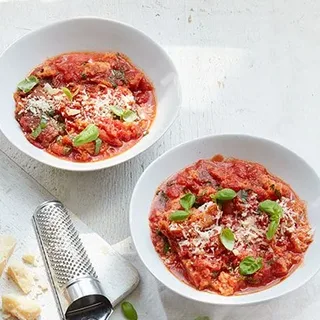
At the end everyone photographs their plate and the photos stay covered until the last person has served, then uncover at once. Five people cooking one recipe produce five noticeably different dinners, and seeing them together is closer to sitting down together than a trickle of photos arriving one at a time.
Party size goes by plan: one guest on the free plan, up to four on sugo+, and up to ten on famiglia.
What this does not do. It is not a video call and it is not a broadcast. Voice stays between the people in the party, there is no audience, nothing is recorded and there is no replay afterwards. That is the right default and it is also a limitation, because if you wanted a keepsake of the evening, the covered plates are the only one you get.
Everyone needs Sugo open and a working connection, so a kitchen with unreliable wifi is still a kitchen with unreliable wifi, and a party is only as good as its worst signal.
It also does not solve the shopping. Two countries means two shops, and the substitution problem stays yours: Ask Sugo will suggest a swap for the ingredient nobody can find, and a suggested swap can be plausible and wrong, so somebody still has to decide and check it. Nor can it make two people cook at the same speed. It gives the gap somewhere to sit, which turns out to be the whole job.
Running one, in order
Pick the dish before you pick the hour
A long middle step and a short end. The clock follows from the dish, not the other way round.
Write one version and send it
One unit system, a named oven type, a pan size, and the substitutions already chosen.
Compare shopping lists the day before
Anything one of you cannot buy is a decision, and it is a much cheaper decision on Tuesday than on Saturday.
Prep before the call
Arrive chopped. Start the call at the part worth sharing.
Name the step where the first one waits
Out loud, before you begin, so that waiting is the plan rather than an apology.
Eat at the same time
Even if it is breakfast for one of you. This is the whole reason you did any of the rest.
The short version
Cooking together was never really about watching each other cook. It is about arriving at a table at the same time with the same dinner on it, and then staying there a while.
Distance takes away the shared pot, not the company. So give the recipe one long step, agree on the numbers in advance, and hand the timekeeping to something that is not either of you.
Sugo is free on iPhone, iPad and Mac, on Android, and in any browser at app.sugo.kitchen. If the person you most want to cook with lives four time zones away, download Sugo.