What to do when a recipe disappears from a website
A saved link is a pointer to someone else's file. How to get back a recipe that has gone, and how to stop it happening to the rest of them.
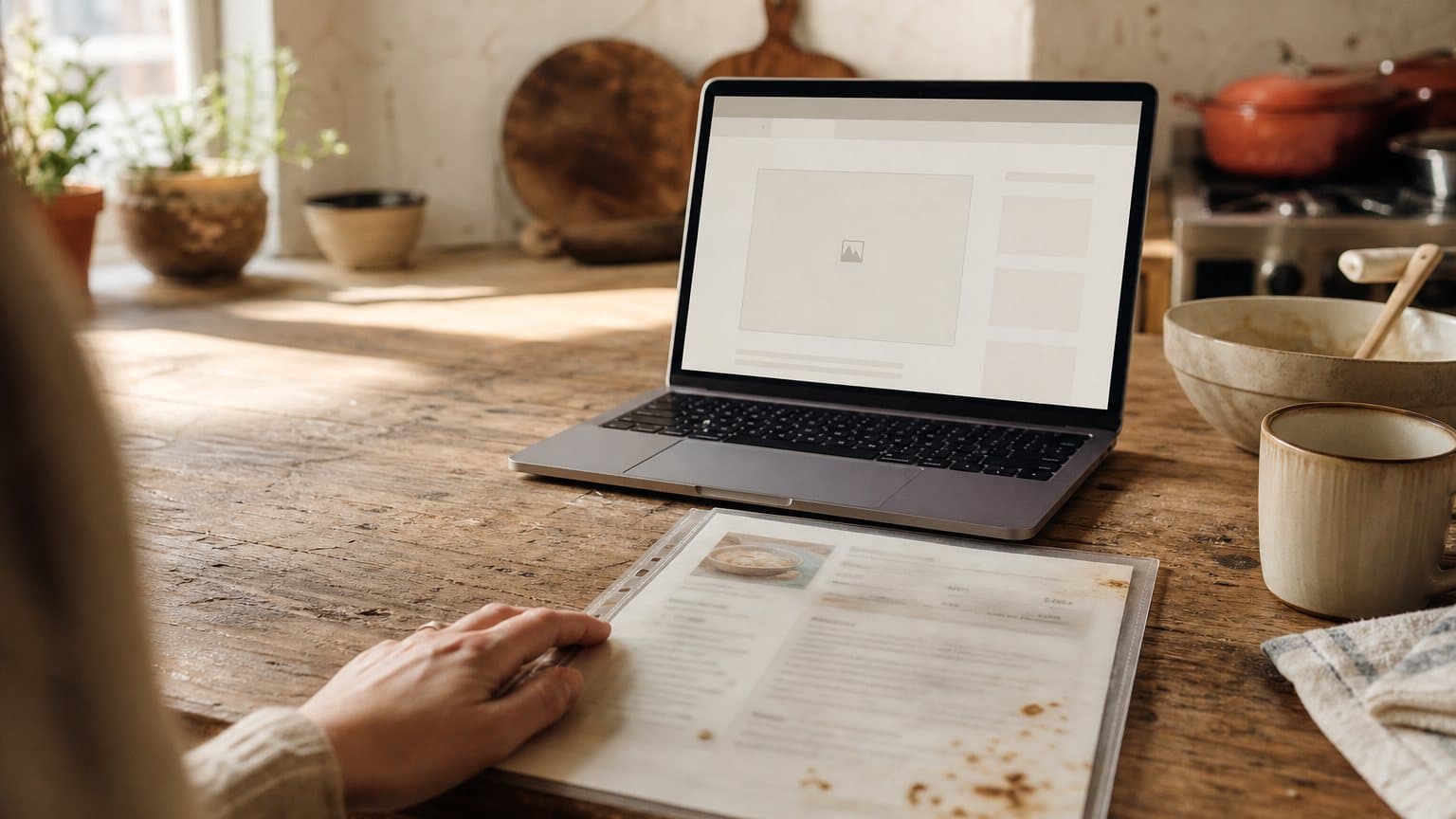
Paste the dead address into the Wayback Machine at web.archive.org and pick a snapshot from before it broke. That gets most of them back. If there is no snapshot, search a distinctive phrase from the recipe inside quotation marks, because popular recipes get scraped, reposted and pinned, and one of those copies usually outlives the original. If that fails too, write to whoever published it. The file is very often still on their laptop and they will send it.
Then do the part that matters more, which is making sure the next one does not go the same way.
Because the recipe did not disappear. Your access to it did. Those two things look identical from where you are standing, and they only look identical because you never had a copy of your own.
"Saved" is the wrong word for what happened
Almost every save button on the web saves a pointer. A browser bookmark is an address. A Pinterest pin is an address with a picture stapled to it. Tapping the heart on a recipe site writes a row in that site's database saying you liked their page, which is a note about their file, not a copy of it. Even the tab you have left open for three weeks is just an instruction to go and ask again later.
The odd exception is the screenshot, which really is a copy, and is by some distance the most durable thing in most people's collections. It is also unsearchable, unsortable and unreadable at arm's length, which is why nobody counts it.
What a bookmark holds
An address. It works for exactly as long as someone else keeps paying for the thing at that address, and keeps it at that address, in the form you liked.
What a copy holds
The ingredients, the quantities, the method, the version you cooked. It survives a redesign, a hosting bill, a change of owner and a change of mind.
Nobody notices the difference because pointers work nearly all of the time. The annual failure rate of any one link is low. Applied to two hundred links collected over five years, it stops being low, and the ones that break are not random: the small independent blog with the genuinely good braise is far more fragile than the corporate site with the mediocre one.
The five ways a link stops working
Only two of them announce themselves.
One saved link, five years
- Year one. Redirects to the homepage.
The site reorganised. Old addresses point at the front door rather than 404ing, so nothing looks broken until you notice you are not where you meant to be.
- Year two. 404, gone.
A move from one publishing platform to another. Honest, at least. You know immediately that you have lost it.
- Year three. Behind a newsletter wall.
Still there, still indexed, now asking for an email address before it will show you the method you have read forty times.
- Year four. Rewritten, different quantities.
Same address, same title, updated for search. The recipe you cooked is not the recipe on the page any more, and nothing tells you it changed.
- Year five. Exactly what you saved.
Your own copy. Unchanged, because nobody else can reach it.
The redirect and the rewrite are the interesting ones, because neither registers as a loss. A redirect to the homepage is a soft 404: your bookmark still opens something, so it stays in your list looking healthy for years. And the silent rewrite is worse than deletion. You go back to a recipe you have made ten times, the page loads, the title is right, and the sugar has quietly changed from 80g to 140g because the post was rewritten to match what people search for. You will not spot that. You will follow it, and the cake will be wrong, and you will assume you made a mistake.
Getting this particular one back
Roughly in order of effort.
1. The Wayback Machine
Go to web.archive.org, paste the URL, and pick a date from before the trouble. For a recipe that had any readership at all, the odds are decent, and you often get several snapshots, which lets you find the version you actually cooked rather than whatever it became.
The limits are worth knowing. It only has what it crawled, so an obscure post from a small blog may have been captured once or never. Images frequently did not archive even when the text did, which hurts if the recipe leaned on a picture of the right dough. And a site can ask to be excluded, in which case there is nothing there at all.
2. Search a phrase from it
Take a sentence you remember, put it in quotation marks, and search it. Recipes get copied around the web constantly: aggregators, content farms, forum posts where someone pasted the whole thing, a Pinterest description containing the full ingredient list.
This is a slightly uncomfortable route, because most of those copies exist without the author's permission and that is a real problem for the people who write recipes. It is nonetheless where the text often survives. Take what you need, and go and find the author afterwards.
3. Look for where the author went
A blog going quiet rarely means the person stopped cooking. They moved to a newsletter, a video channel, or a book, and a good share of the old material came with them. Search their name rather than the recipe title.
4. Ask
Underrated. People who wrote a recipe blog in 2019 usually still have the drafts, and an email that says "I made your leek and cider pie constantly and the page is gone, do you still have it" gets answered surprisingly often. It is the only route on this list that can recover something the internet no longer holds at all.
5. Rebuild it from the pieces you already have
When no single source has the whole thing, the fragments will usually add up. This is more common than a clean recovery, and less painful than it sounds.
One recipe, close enough to cook on Thursday
Your own traces are the part people forget. Browser history, the email you sent yourself, the photo you took of the finished thing, the message where you sent it to a friend. Any one of those can supply the number the archive lost.
Keeping your own copy
Everything above is recovery, which is work you do because you did not do the cheaper thing first. The cheaper thing is taking a copy at the moment you save, when the page is definitely still there.
That is what Sugo does with a link. You give it the address of a recipe and it comes back as a structured recipe held in your cookbook: title, ingredients with real quantities, numbered steps. From that moment the page can be redesigned, walled, rewritten or deleted, and none of it reaches your copy. The source link stays attached so you can go back for the writing around the recipe, and so the credit points where it should.
ask sugo
The difference only shows up later. A collection you own is searchable by ingredient and by half-memory, so "that pie from the blog that shut down" is a question with an answer. It gets matched against your pantry. And it works in cook mode with the steps one at a time, which no archived web page will ever do. If your recipes are currently spread across screenshots and saved posts, how to save recipes so you actually cook them covers the sorting problem, and saving recipes from TikTok and Instagram is the same argument for a place where things vanish considerably faster.
What this does not do. Two honest limits, and the first one is the whole subject of this post.
Sugo cannot import a page that is already gone. It reads a live URL, so a dead address is dead to it as well. The sequence for a recipe you have already lost is recovery first, by whichever route above works, and then import whatever you recovered. Feeding it an archive snapshot URL usually works, and is worth trying before you retype anything by hand.
The second is the flip side of owning a copy. A copy is a snapshot, so it does not improve when the author does. If they revise a recipe in 2028 after making it another hundred times, your version stays at the 2026 wording. That is a genuine trade rather than a pure win: you are choosing a version that cannot be taken away over a version that stays current. For most home cooking it is the right trade, but it is a trade, and keeping the source link is how you can go and check.
Extraction is not perfect either. Sites with unusual layouts, recipes buried in a long essay, and quantities written only in prose all produce imports worth reading before you trust them.
What to do this week
Open ten old bookmarks
Not all of them, ten. It tells you your own failure rate, which is the only number here that matters, and it is usually worse than expected.
Deal with the redirects first
Anything that opens a homepage instead of a recipe is already lost and is not advertising the fact. These are the ones the Wayback Machine is likeliest to have.
Rescue the ones you actually cook
A collection of two hundred links probably contains fifteen recipes you have made more than once. Those fifteen are the whole job.
Keep the source with the copy
So credit goes to the author, and so you can go back for the notes and photographs a plain ingredient list leaves behind.
Change what saving means
From now on, take a copy at the point of saving. Recovery is expensive and lossy. The copy costs nothing while the page is still up.
The short version
Link rot is not an internet problem you are unlucky to have run into. It is the ordinary behaviour of a system where you never held the file.
The web is a wonderful place to find recipes and a poor place to keep them, and those two facts are not in tension, they just describe different jobs. Find them out there. Keep them somewhere you control.
Sugo is free on iPhone, iPad and Mac, on Android, and in any browser at app.sugo.kitchen. If your recipe collection is a folder of bookmarks you are slightly afraid to test, download Sugo.